

In development
Online reputation agent
Plans the editorial calendar, writes for each network and creates visuals in your brand. Nothing is published without your approval.
Task automation
An AI agent is not an assistant you question. It is software that takes responsibility for a repetitive task from end to end: it prepares, proposes, waits for your approval, then executes.
We design these agents around your tools and data, then operate and maintain them for you.
Contact usThe difference comes down to one word. An assistant answers; an agent acts. These are tasks we can entrust to an agent. They are not demonstrations: they are jobs already occupying someone in your organisation.
Plans the editorial calendar, writes for each network and creates visuals in your brand. Nothing is published without your approval.
Turns your footage into short videos for each platform, using your titles, colours and expected formats.
Sorts incoming messages, summarises what matters and prepares recurring replies. You review and send.
Drafts quotations and invoices from your templates and terms, including the follow-ups you have defined.
Produces testimonial or demonstration videos from a script for your social channels.
Which task returns every week, follows the same rules and teaches its owner nothing new? If you have an answer, there may be an agent to build.
We are building a communication agent for social media, and 3N is its first user. We will not sell you a tool that we do not use ourselves.
A monthly calendar: topics, dates, formats and networks.
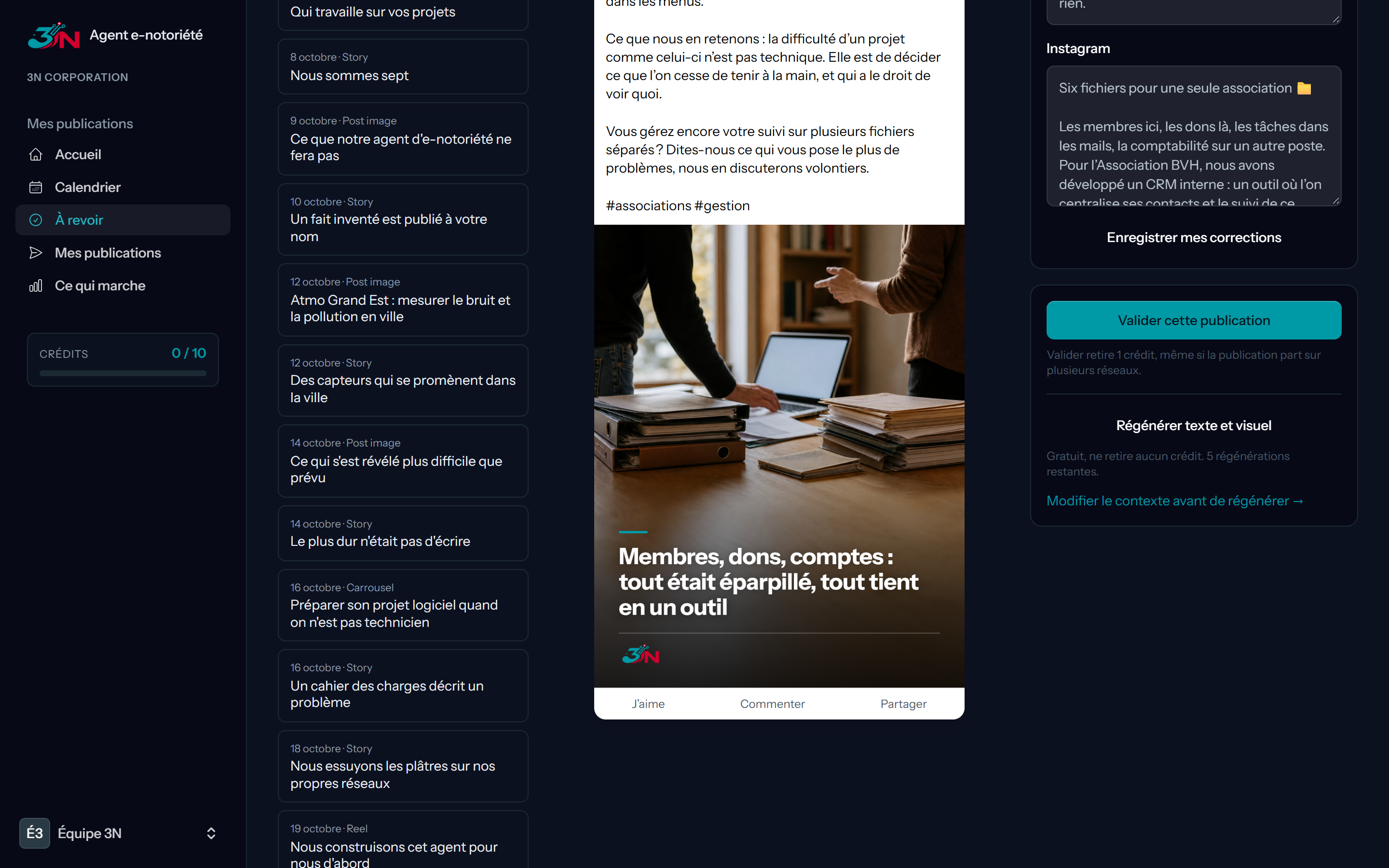
Open a publication, explain what you want to say and choose your images.
Copy for each network, a visual in your brand and animation where needed.
Nothing leaves without approval. Correct it, regenerate it or validate it.
It is the first justified question every leader asks. Our answer rests on three rules enforced in code rather than left as a commercial promise.
For anything visible outside your organisation—a post, email or quotation—the agent prepares and stops. A person validates. That is the default.
A model left alone fills gaps with convincing inventions. We strictly define the subjects and information it is allowed to use.
Dates, formats and amounts are checked by code before storage. Incorrect data silently recorded is worse than a visible error.
Before building agents, we integrated artificial intelligence into systems delivered to clients and running in production.
An AI assistant inside a wind-farm maintenance application, with mobile and back-end algorithms working together.
An AI chatbot inside an association CRM covering members, donors, projects and accounting.
Algorithmic processing of noise and pollution sensor data for the Grand Est region.
None of these three is an agent in the sense used on this page. They assist, analyse and answer, but do not carry a task from end to end. We make the distinction because “agent” is now applied to many systems that are not agents.
An AI agent has two costs. First comes design and connection to your tools. Then comes usage: each time the agent works, it consumes computing capacity from the model provider. This second cost is often left unmeasured.
We begin with a measured trial on one task, not with a full construction project. It reveals the cost per operation and the time genuinely saved. You decide whether to continue using your figures, not our estimate.
Start with a frequent task governed by stable rules and where an error can be recovered. Choose the most profitable, not the most spectacular.
A reduced version runs on real data. We measure output quality, time saved and cost per operation.
The agent connects to your tools with the controls and approvals agreed together.
Your teams are trained, errors are monitored and the agent is adjusted through its first weeks.
Describe the task, its frequency, the tools involved and what must remain under human control. We will tell you whether an agent is the right answer—and say so clearly if it is not.